Pearson Edexcel · GCSE · History
Course version: 1HI0 · Version from Sept 2016
The historic environment - 1 Whitechapel, c1870–c1900: crime, policing and…
Full specification wording
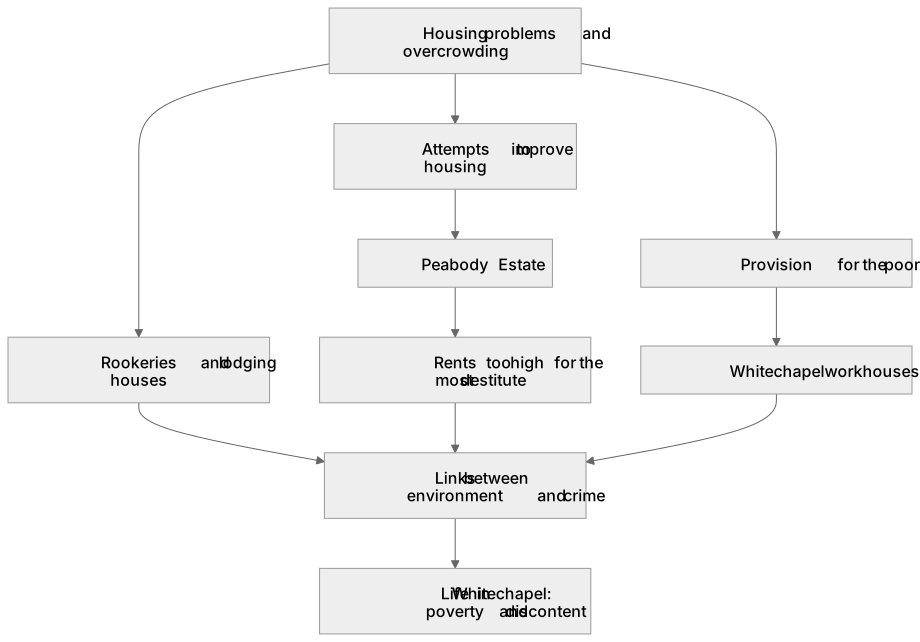
Option 10: The historic environment - 1 Whitechapel, c1870–c1900: crime, policing and the inner city: The local context of Whitechapel. The problems of housing and overcrowding. Attempts to improve housing: the Peabody Estate. Provision for the poor in the Whitechapel workhouses. Links between the environment and crime. Life in Whitechapel as an inner city area of poverty and discontent.
Late 19th-century Whitechapel was an inner-city area defined by severe poverty, discontent, and a transient population.
Checked against the Pearson Edexcel 1HI0 specification (opens in a new tab) on .
- Point 1 of 5
- 4 key terms
Study notes
From the checked teaching notes for this specification point.
The idea
Late 19th-century Whitechapel was an inner-city area defined by severe poverty, discontent, and a transient population. The local context was dominated by appalling housing problems, with extreme overcrowding in slum rookeries and lodging houses where disease spread rapidly. Attempts to improve housing included the Peabody Estate (1881), providing model dwellings for the working poor, though rents were often too high for the most destitute. Provision for the poorest relied on the dreaded Whitechapel workhouses and casual wards, designed to be harsh to deter reliance. There were clear links between this environment and crime; the labyrinthine dark alleys facilitated theft and prostitution, while desperate poverty drove many to criminal acts for survival. Life in Whitechapel was a struggle against squalor, creating a volatile atmosphere that challenged policing.
What earns the marks
- Describe the severe housing problems and overcrowding in Whitechapel's rookeries and lodging houses.
- Evaluate the impact of the Peabody Estate as an attempt to improve local housing conditions.
- Explain the role and conditions of the Whitechapel workhouses in providing for the poor.
- Analyse the links between the physical environment of Whitechapel (e.g., dark alleys, poverty) and the prevalence of crime.
Common mistakes and how to put them right
Assuming the Peabody Estate solved the housing crisis in Whitechapel.
Put it right: Note that while it improved conditions for some, the poorest residents could not afford the rents and were displaced.
Confusing workhouses with prisons.
Put it right: Clarify that workhouses were institutions for the destitute poor, not penal facilities, although conditions were deliberately harsh.
Describing Whitechapel's population as static.
Put it right: Emphasise the transient nature of the population, including immigrants and seasonal workers, which added to the area's instability.
Exam tips
- Use specific terminology like 'rookeries', 'doss houses', and 'sweatshops' to demonstrate detailed knowledge of the local context.
- When discussing the links between environment and crime, explain how the physical layout (narrow, unlit streets) made policing difficult and aided criminals.
- Connect the poverty and discontent in Whitechapel to the broader social tensions of the period, including anti-immigrant sentiment.
Try the lesson
The start of the Option 10: The historic environment - 1 Whitechapel, c1870–c1900: crime, policing and the inner city: The local context of Whitechapel. The problems of housing and overcrowding. Attempts to improve housing: the Peabody Estate. Provision for the poor in the Whitechapel workhouses. Links between the environment and crime. Life in Whitechapel as an inner city area of poverty and discontent. lesson, made from checked teaching notes for this specification point.
Have a go first
What was the Peabody Estate, which opened in Whitechapel in 1881?
Listen
Late 19th-century Whitechapel was an inner-city area defined by severe poverty, discontent, and a transient population. The local context was dominated by appalling housing problems, with extreme overcrowding in slum rookeries and lodging houses where disease spread rapidly. Attempts to improve housing included the Peabody Estate (1881), providing model dwellings for the working poor, though rents were often too high for the most destitute. Provision for the poorest relied on the dreaded Whitechapel workhouses and casual wards, designed to be harsh to deter reliance. There were clear links between this environment and crime; the labyrinthine dark alleys facilitated theft and prostitution, while desperate poverty drove many to criminal acts for survival. Life in Whitechapel was a struggle against squalor, creating a volatile atmosphere that challenged policing. A strong answer earns marks for these points. Describe the severe housing problems and overcrowding in Whitechapel's rookeries and lodging houses. Evaluate the impact of the Peabody Estate as an attempt to improve local housing conditions. Explain the role and conditions of the Whitechapel workhouses in providing for the poor. Analyse the links between the physical environment of Whitechapel (e.g., dark alleys, poverty) and the prevalence of crime. A common slip: Assuming the Peabody Estate solved the housing crisis in Whitechapel. Instead, Note that while it improved conditions for some, the poorest residents could not afford the rents and were displaced. Exam tip: Use specific terminology like 'rookeries', 'doss houses', and 'sweatshops' to demonstrate detailed knowledge of the local context.
See it
Key words
Say what each word means before you turn the card.
Poverty and public health
Try answering aloud or in your head before turning the card.
Urban environment
Try answering aloud or in your head before turning the card.
Social reform
Try answering aloud or in your head before turning the card.
Crime and policing
Try answering aloud or in your head before turning the card.
See every definition
- Poverty and public health
- Life in Whitechapel was an inner city area of poverty and discontent, with disease spreading rapidly in overcrowded slum rookeries and lodging houses.
- Urban environment
- The local context of Whitechapel was dominated by appalling housing problems and extreme overcrowding in slum rookeries and lodging houses.
- Social reform
- Attempts to improve housing included the Peabody Estate, providing model dwellings for the working poor, though rents were often too high for the most destitute.
- Crime and policing
- There were clear links between the environment and crime, as the labyrinthine dark alleys facilitated theft and prostitution, while desperate poverty drove many to criminal acts for survival.
Label the diagram
Some boxes have lost their names. Pick the right name for each number.
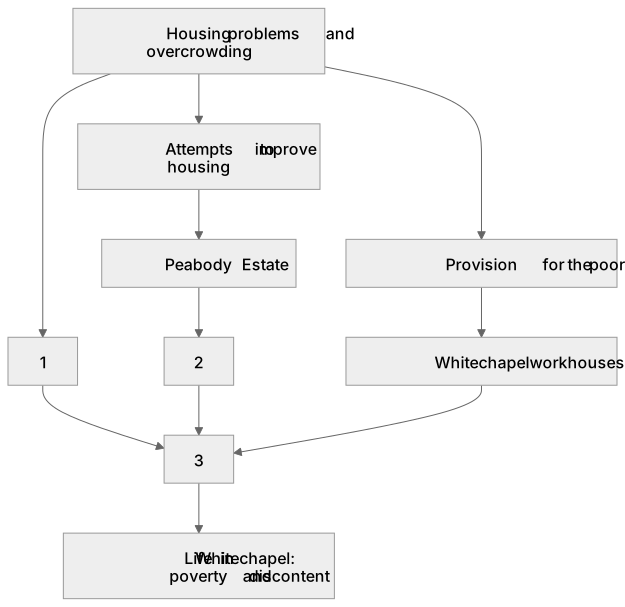
1Box 1
2Box 2
3Box 3
There is more to this lesson
The full lesson goes on to check your understanding and help you earn the marks. Create a free account to carry on, with your progress saved.
A week of Premium from your first lesson · Then the free plan continues · No card, no charge
Test your understanding of Option 10: The historic environment - 1 Whitechapel, c1870–c1900: crime, policing and the inner city: The local context of Whitechapel. The problems of housing and overcrowding. Attempts to improve housing: the Peabody Estate. Provision for the poor in the Whitechapel workhouses. Links between the environment and crime. Life in Whitechapel as an inner city area of poverty and discontent.
Active recall beats re-reading. Take an instant quiz now to test what you’ve learned and lock it into long-term memory.
A week of Premium from your first lesson · Then the free plan continues · No card, no charge